
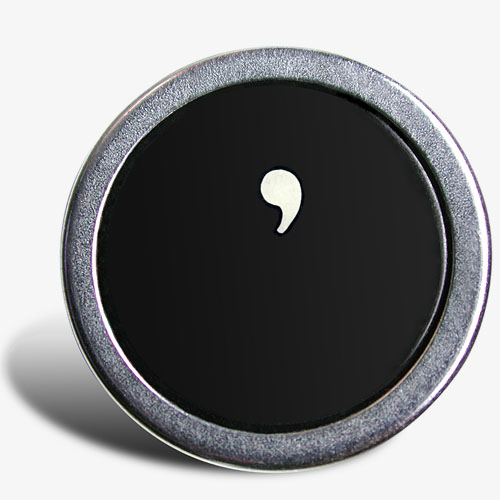
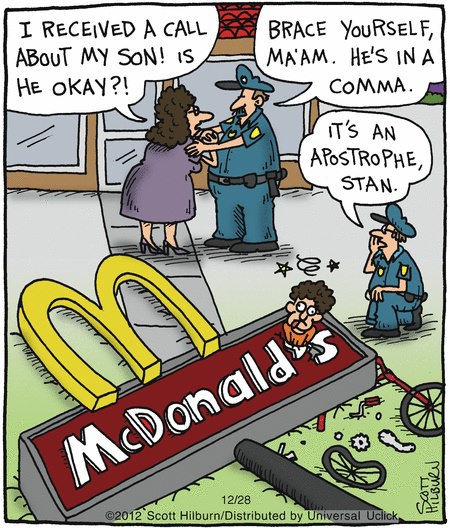
In the English language, the apostrophe has a lot to do with possession and omission. Its misuse as a punctuation mark in words is a hot topic for editors and proofreaders, and anyone else who cares. There are many rules to consider regarding the apostrophe, but the trend today is to say or write something in the briefest way possible—social media has made sure of that—and the apostrophe is losing traction.
Indicating ommission
A contraction combines two or more words by removing one or more letters, replacing them with an apostrophe (don’t, couldn’t, or cont’d instead of continued) It’s (it is) even becoming increasingly acceptable to leave out the apostrophe altogether (dont, couldnt, contd).
Gone fishin’ is likely to lose its apostrophe – gone fishin.
Showing possession
The use of the apostrophe to show possession with a singular noun is basic stuff: an apostrophe is inserted plus the letter s (the artist’s palette, Tim’s book). But when it comes to common nouns that end in the letter s (bus, glass, brass) and proper nouns (Harry Harris, Athens, Christmas), there are conflicting grammar rules about how to show possession when writing such nouns.
Harry Harris’ recital or Harry Harris’s recital
This may help:
“A competing rule has it that names consisting of one syllable always take an apostrophe s (Burns’s), whereas those of more than one syllable take only the apostrophe (Dickens’) . . . Given this confused situation, the most straightforward course of action is to add apostrophe s to any name ending in s, however long or short it is and however it is pronounced.” (Wiley Style Manual, p. 86)
I change my mind regularly, and my choice often depends on how the word looks. So there is no right way; the best advice I should give myself is to choose one way and stay consistent. I tend to be minimalist so I don’t usually add the s after the apostrophe.
If the ‘possessive’ belongs or relates to more than one person, only add an apostrophe to the last person in the grouping. The example below indicates that these two aritsts work together to paint one painting:
Brown and Green’s paintings depict the war in Iraq.
Using the above example, if Brown and Green painted separate paintings of the same subject, then each name would take an apostrophe:
Brown’s and Green’s paintings depict the war in Iraq.
Curiously, possessive pronouns such as its, hers, yours, ours, whose and theirs never have an apostrophe before the s.
Plural and collective nouns not ending in s also take an apostrophe s.
children’s books (not childrens’ books)
women’s rights (not womens’ rights)
To add an apostrophe or not …
Place names and companies such as Kings Cross and Bakers Delight don’t need an apostrophe s (Kings Cross is not King’s Cross or Kings’ Cross). The same applies to generic phrases that are descriptive such as travellers cheques or someone’s drivers licence.
Nor are there apostrophes in decades such as the 1960s, not the 1960’s; although, an apostrophe would be added if it was abbreviated to ‘the ’60s’.
Even though it was previously the norm to add an apostrophe, these days there are no apostrophes in expressions of time that denote more than one day, week, month or year (probably because the sense of these phrases are considered to be more descriptive than possessive).
in two weeks time
two days work
But if the reference is singular, use the apostrophe.
A month’s holiday
However, Simon Heffer (Simply English: An A to Z of Avoidable Errors) still advocates the use of an apostrophe, as in ‘it was two years’ work’, arguing that it means ‘the work of two years’. On the other hand, he explains that phrases such as ‘she was eight months pregnant’ denotes that ‘eight months’ is used adjectivally.
There are no apostrophes in the plural form of acronyms.
NGOs
MPs
URLs
It’s worth taking note of the rules relating to the use of an apostrophe if you’re serious about writing, but in the modern world, it seems to be gradually losing its grip …
Are you ready …
 to have your writing edited or proofread?
Or maybe your unpublished book, whether fiction or non-fiction, needs an assessment before you consider publishing.
You’re welcome to email me on denise@denisemtaylor.com.au or via my contact page with a brief overview. I’d be delighted to help you finetune your writing project and bring it to completion ready for publication.
My editing is based on the Australian Style Manual (ASM) unless an author has been commissioned to write a book using the publishing house style guide.