
There is a lot to be learned about the art of creating fictional characters from Geoffrey Chaucer’s ‘The Canterbury Tales’. When I assess a narrative, I often comment that I don’t have a clear visual of a character. Or a character doesn’t have a distinctive voice. Or the voice doesn’t match the character.
I recently went through my home library and came across ‘The Canterbury Tales’ (a collection of twenty-four stories written in Middle English between 1387 and 1400), which I studied many years ago and often revisit. In the ‘General Prologue’, each character who joined the pilgrimage to Canterbury Cathedral is introduced. They assembled at the Tabard Inn in London on an April evening at the end of the fourteenth century to begin their journey.
Chaucer, as narrator and fellow pilgrim, closely observes each travelling companion. He describes them with words that become brush-strokes, ‘painting’ a revealing portrait of external features, mannerisms and occupations. Words are often loaded with irony and suggestion. They could be short, long, guttural, arranged in soft rhyming couplets or harsh staccato formats — verbal components that build a visual image of each pilgrim. Descriptions of clothing, accessories, hairstyles, food preferences, social graces, moral attributes and physical features weave a tonal tapestry of this group of pilgrims.
I have chosen four of Chaucer’s pilgrims and considered the relationship between the verbal and visual components of the descriptions — the uncouth Miller, the worldly Prioresse, the youthful Squire, and his father, the saintly Knight (the names denote their professions and remain capitalised even though in today’s prose they would not be). The roll-call of characters accords with medieval dedication to hierarchy, beginning with the Knight and ending with the unscrupulous Miller.
The ‘worthy’ Knight
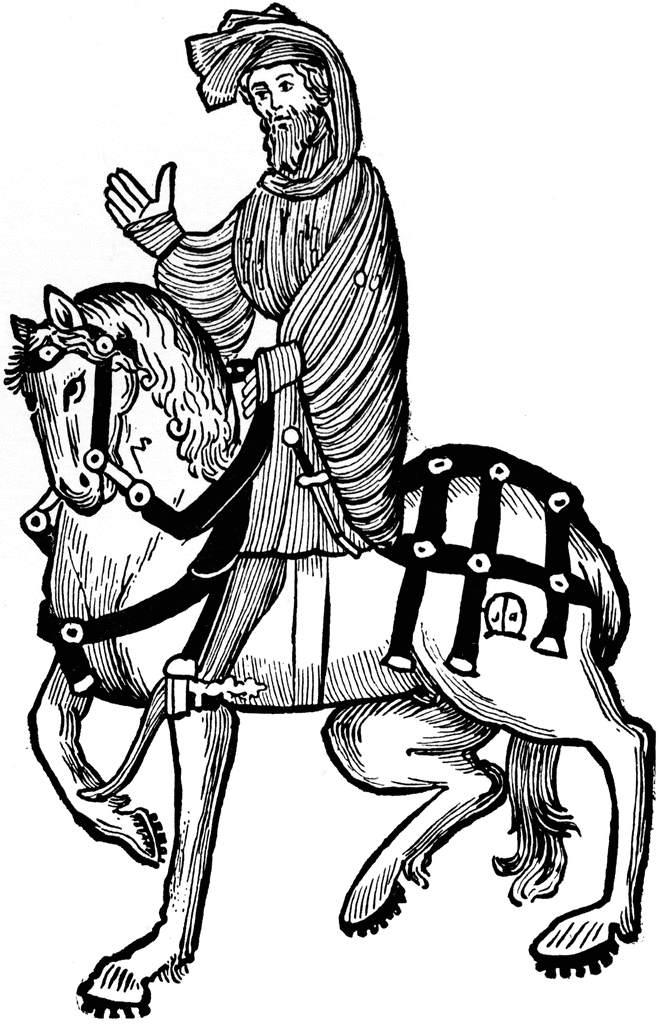 Chaucer chooses the ‘worthy’ Knight as the first in his roll-call of pilgrims in the General Prologue. This portrait receives thirty-five lines of description and focusses on a man whose moral attributes overshadow his external appearance. It is obvious from the start that this is the ideal Christian knight.
But Chaucer also describes him ‘as meeke as is a mayde’. The soft nasal consonant, ‘m’, conveys a gentle man. His facial features are not verbalised — could this be an indicator that this knight is more of a god-like man? He is ‘nat gay’ (not brightly dressed), wearing ‘fustian’ (cheap homespun cloth), which is ‘bismotered’ (stained) by the rust from his coat of chainmail. This reinforces the Knight’s dedication to duty and not concerned about his appearance.
In his summing up of the Knight, Chaucer acknowledges this humble man: ‘He was a verray, parfit, gentil knyght’. His horse is even ‘gode’.
If we think of this description of the Knight and apply it to a modern character, maybe the author could be setting up this character as exemplary, then revealing less attractive details of his life later in the novel. For example, what really happened on the battlefield? Beneath the surface, is this man a profiteer?
The ‘lusty’ Squire
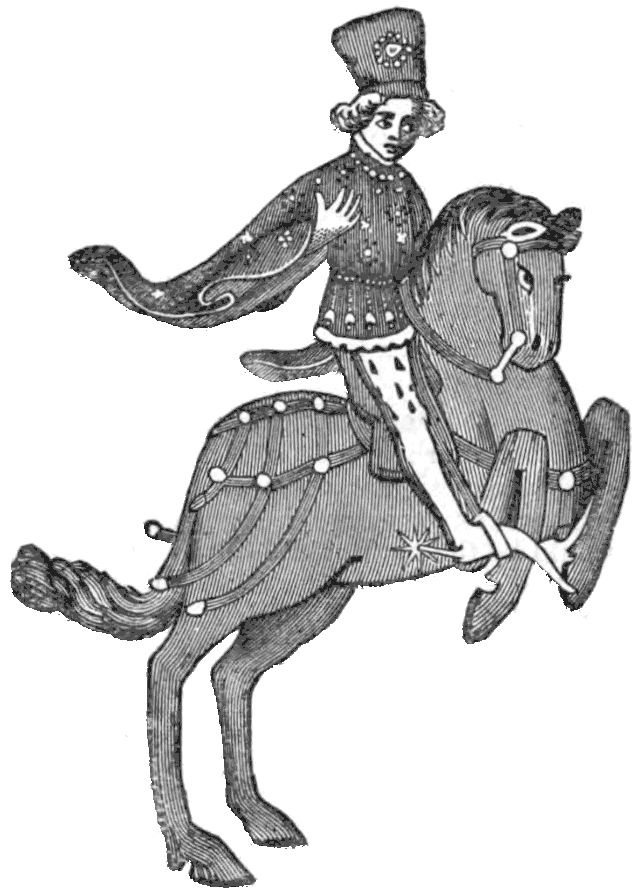 The Knight brings with him his twenty-year-old son. Chaucer’s description of the Squire creates a contrasting, more colourful visual image of the present breaking forth with youthful energy. The Squire was: ‘A lovyere, and a lusty bacheler’, who loved ‘hote’, sleeping no more than a nightingale and with ‘so litel space’ for battle and duty. His image is constructed by the use of active words such as ‘lusty’, ‘singinge’, and ‘floytinge’ — symbolism of life bursting forth in April showers. The Squire’s clothes are described as a meadow:
Embrouded was he, as it were a mede
Al ful of fresshe floures, whyte and rede.
The rhythmic alliteration in the last line conveys a vision of the vitality of youth. Nature, and its continuous rebirth, is embodied in the Squire’s portrait and here Chaucer has the cycle in the right order: the Knight, the age-worn father making way for his son, the Squire, embracing life in full throttle. The stark comparison highlights each of the character’s qualities.
Eglentyne the Prioresse
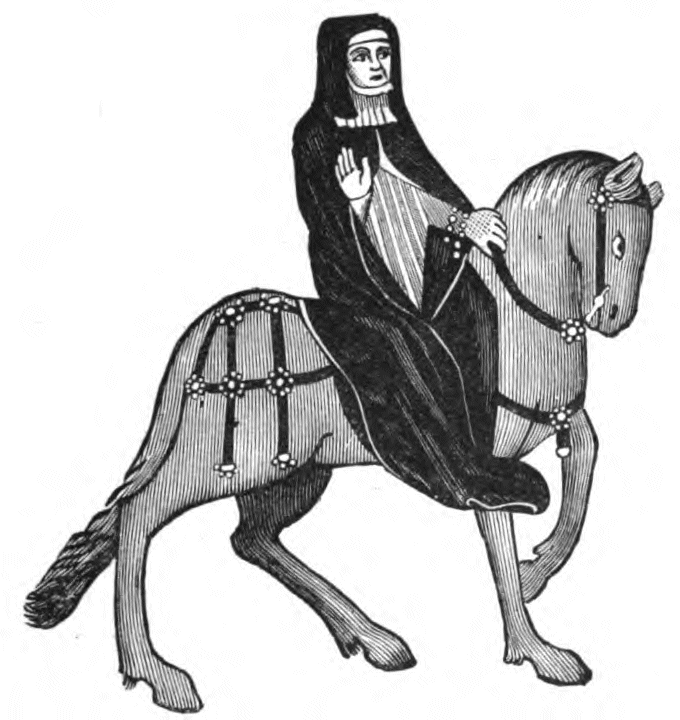 Chaucer’s portrait of the Prioresse is described according to her appearance, possessions and manners. This alerts the discerning audience to a disjunction between her religious role and her love of all things worldly. How can it be that this nun wears bright jewels, has pet lapdogs, and a penchant for courtly behaviour?
The Prioresse’s polysyllabic name, Eglentyne, suggests sophistication and is associated with white and red roses. The reader would doubt that this nun is coy or lives a simple life because Chaucer constructs the romantic ideal of a beautiful woman – a graceful nose, grey eyes and ‘her mouth ful small, and thereto softe and rede’. There is irony in the way the Prioresse sings, with the focus on her intonation rather than its spiritual aspect.
Ful wel she song the service divyne,
Entuned in hir nose ful seemly;
More damning evidence of the Prioresse’s outward signs of showy conceit is her rosary and brooch, which the narrator describes in detail:
Of smal coral aboute hire arm she bar
A peire of bedes, gauded al with grene;
And theron heng a broche of gold ful shene,
Although these adornments define her occupation, the shiny surfaces and colours evoke secular sensuality. The repetitive ‘g’ in ‘gauded al with grene’ and ‘gold ful shene’ is harsh, and brings the reader back to the duality of the portrait — sacred and secular love, spiritual and surface beauty — which is exemplified in the ambiguity of the motto inscribed on her golden brooch: Amor Vinci Omnia (love conquers all).
Chaucer is questioning whether her ‘cheere of court’ and her attractiveness ought to be the most striking attribute of a religious woman. But probing readers will be keen to know the history and motivations of this female pilgrim. This is the essence of good character development: keep the reader engaged (captivated) and wondering …
The ‘thikke’ Miller
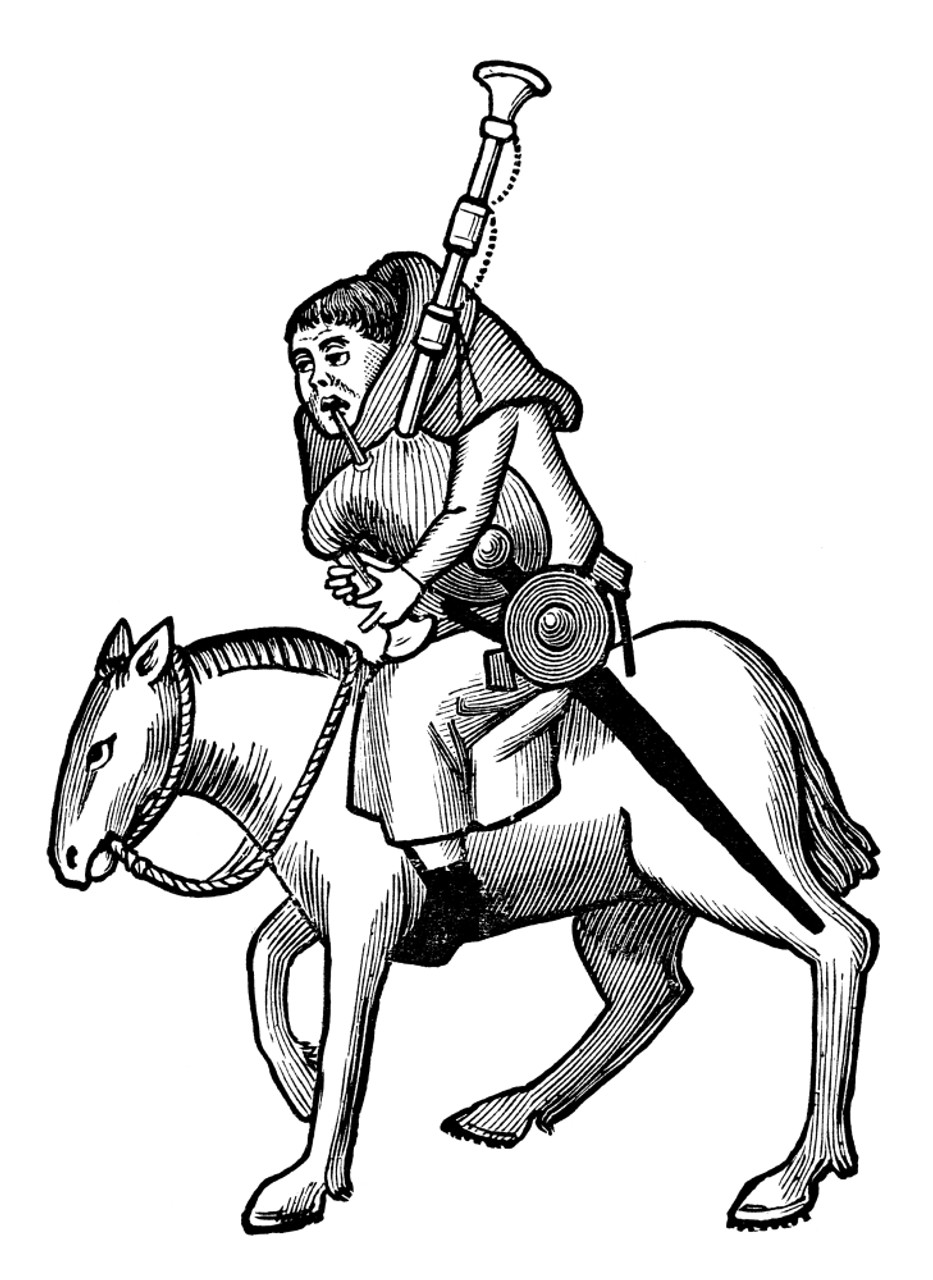 The Miller is aligned with the coarse and the cunning: the sow and the fox. Within the first seven lines of the Miller’s portrait, the reader learns that he fits the subhuman category. The grotesque Miller is described in extreme magnification: ‘a stout carl for the nones’, ‘ful big he was of brawn, and eek of bones’. He is ‘brood’ and ‘thikke’.
The Miller’s character is imprinted and readable on his face. His mouth is described ‘as a greet forneys’ (furnace-like mouth). The reader is forced to view the Miller in close-up with his repulsive black nose hairs and a wart with hairs ‘reed as the bristles of a sowes erys’.
Short sentences exaggerate the coarseness of the character and accentuate the visual image. ‘Janglere’ and ‘goliardeys’ denote a loud and uncouth man simply in the sound of the words. The bagpipe that the Miller ‘wel coude he blowe’ not only conjures up a visual image of a bloated body but also a crude, gluttonous and foul-mouthed man.
***
Like brushes applying paint of different colours and textures to create a visual representation of a sitter, so is the function of poetic form and vocabulary in Geoffrey Chaucer’s ‘The Canterbury Tales’: to construct visual images that reflect the personalities of the pilgrims through vivid descriptions of physical appearance, clothing, accessories and attributes. However, surface details are not always to be taken at face value. The subtle, and not so subtle, verbal interplay that is built into these portraits identifies the diverse means by which Chaucer introduces the pilgrims to the reader.
Chaucer provides a valuable lesson in characterisation that can be useful for contemporary authors of fiction. One of the skills that an author can learn from ‘The Canterbury Tales’ about creating and developing characters is to work with surfaces (appearances) that may (or may not) reveal the true character. With this in mind, it’s often a good idea to gradually reveal descriptive details of appearance and personality. When we meet someone for the first time, we form an impression of the person. However, as a closer relationship is developed, other unexpected characteristics and idiosyncrasies may emerge.
As a post-script, I think Chaucer would have approved this colourful, yet enigmatic, description of a character in Robert B. Parker’s The Godwulf Manuscripts (1973):
He looked like a zinnia. Tall and thin with an enormous corona of rust red hair flaring out around his pale, clean-shaven face. He wore a lavender undershirt and a pair of faded, flare-bottomed denim dungarees that were too long and dragged on the floor over his bare feet.
Intriguing …
Is your writing project ready for a Manuscript Assessment?
 If you are a writing a story, whether it’s short or a novel, and would like an assessment of your characters, plot and choice of point of view, please contact me here
or email me directly: denise@denisemtaylor.com.au
I look forward to ‘hearing’ from you!
Denise
References
Chaucer, Geoffrey. The Canterbury Tales. Ed. Kolve, K. A. and Olson, Glending. 2nd edition. London: W.W. Norton & Co., 2005.
Ellis, Steve, ed. Chaucer: An Oxford Guide. Oxford: Oxford University Press, 2005.
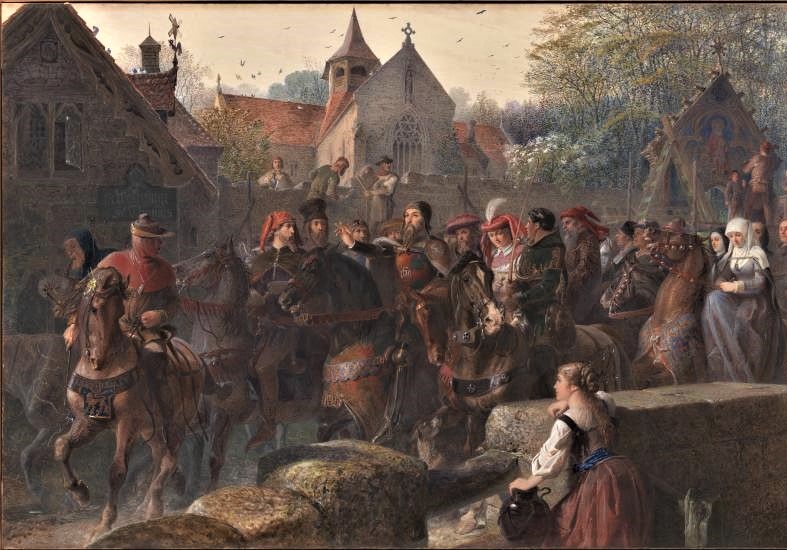
Featured image: Edward Henry Corbould, ‘The Canterbury pilgrims’, 1874, watercolour and gouache over pencil, National Gallery of Victoria, Melbourne.