
Love or hate the semicolon, this controversial punctuation mark certainly has its functional use in a long sentence, which was common in nineteenth-century/early twentieth-century writing. There are times when a semicolon is the perfect punctuation choice in a sentence, particularly when linking two or more independent clauses with closely related content. However, these days, the semicolon is often considered old-fashioned, even pretentious.
What grammar rules relate to semicolons?
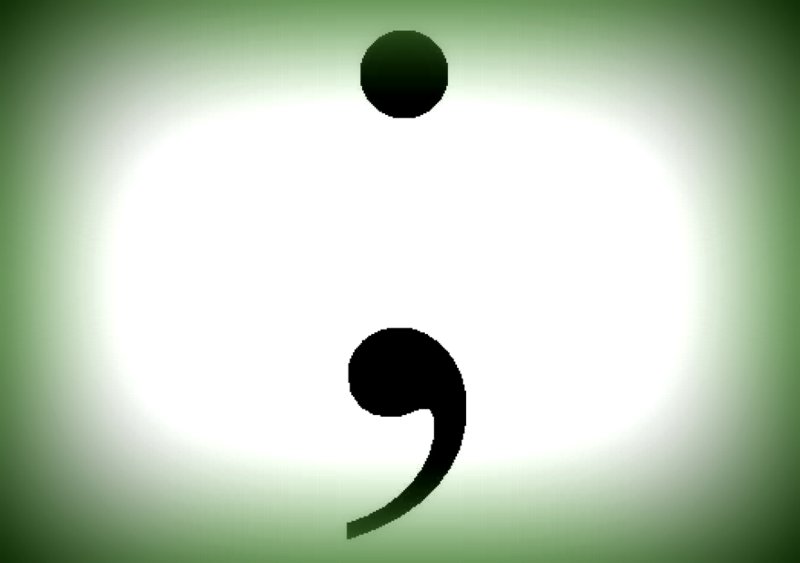
Basically, semicolons introduce a break in a sentence, which is more significant than a comma.
Semicolons have two specific functions:
- A semicolon separates two independent sentences that are set together as one but with similar content. For example:
Secular patronage was fuelled by the Renaissance brand of humanism; there were also important technical developments.
See below for an alternative way of writing this with a full stop instead of a semicolon. However, this version with the semicolon emphasises the closeness of the two statements. Note that they could be linked with a conjunction:
Secular patronage was fuelled by the Renaissance brand of humanism, and there were also important technical developments.
- A semicolon punctuates a complex list. I recently read Pip Williams’ new book, The German Ward. Here is a sentence where she appropriately uses semicolons:
There were sketches of the camps, rows of tents; long wooden hospital huts; a soldier with his horse in the dunes; a group of Chinese unloading goods from a train; a matron bent to her notes.
Today, writers of fiction tend to use semicolons sparingly, and only when grammar rules insist. Teacher of writing and the humanities, Cecelia Watson, who considers herself a “reformed grammar fetishist”, argues in her book Semicolon, that writers don’t have to be religiously tied to grammar rules because rules can limit our relationship with language, and “true communication and openness to others”.
A loathing for semicolons
Editor Stephen Romei (The Australian, 10 August 2019) admitted that he loathed the “scandalous” semicolon, preferring full stops and commas. He apologised profusely to writer Carmel Bird, who had declared during an e-chat with him that “a rogue semi-colon had barged into her review of Jane Sullivan’s wonderful book, Storytime”. Romei was horrified: “I assured Carmel I did not grant it entry (it appeared during the production process)”.
However, Carmel Bird did make use of the semicolon in her book Writing the Story of your Life:
Such incredibly simple [life story] beginnings as: ‘I remember one day when my aunt . . .’; I remember the time when I lost . . .’; ‘I remember a teacher . . .’; . . .
This proves that semicolons do have a genuine purpose when listing related independent clauses, which is particularly viable in non-fiction writing.
Choosing semicolons in non-fiction books and scholarly writing
When two independent clauses are linked with ‘however’, I prefer using a semicolon to emphasise comparison without creating two separate sentences. For example:
Secular patronage was fuelled by the Renaissance brand of humanism; however, there were also important technical developments.
However, many writers would prefer two sentences:
Secular patronage was fuelled by the Renaissance brand of humanism. However, there were also important technical developments.
Then there are writers who would just insert a comma between the clauses:
Secular patronage was fuelled by the Renaissance brand of humanism, however, there were also important technical developments.
It’s all a matter of taste.
Semicolons in fiction
In the past, when the average sentence was much longer, semicolons were regularly used as sentence dividers. American-British author, Henry James (1843-1916), extended sentences to create a rhythm or a flow-through of characters’ thoughts. James’ creation, Isabel Archer, is a mesmerising character. James allowed the reader access to Isabel’s thoughts. In the following sentence, four clauses linked by semi-colons perfectly demonstrate the development of Isabel’s reflective thought process.
For herself nothing was changed; what she once thought of him she always thought; it was needless this feeling should change; it seemed to her in fact a better feeling than ever. (The Portrait of a Lady, 1881, Chapter 42)
The semicolons in this sentence slow the reading process without stopping completely, which maintains the reader’s focus.
Full stops instead of semicolons in fiction
Short sentences in fiction express a complete thought for dramatic effect, and force a powerful silence after the full stop. Taking another example from The German Ward, Williams wrote:
He bled to death. It didn’t take long.
The full stops add a sense of tragic finality to the young soldier’s short life, which a semicolon would diminish: He bled to death; it didn’t take long.
The following extract from Arundhati Roy’s The God of Small things (1997) illustrates how short sentences add tension, allowing space for readers to soak up the atmosphere of pivotal moments in the narrative.
The Inspector asked his question. Estha’s mouth said Yes.
Childhood tiptoed out.
Silence slid in like a bolt.
Someone switched off the light and Velutha disappeared.
The dash instead of the semicolon?
The em or the en dash is being used more frequently these days to replace the semicolon. Watson calls it the Era of the Dash. English author, Virginia Woolf (1882 1941), frequently used semicolons, even when writing in her diary. Here is an example:
Silence in company; or the quietest statement, not the shortest; is also “medicated”, as the doctors say. (A Writer’s Diary, 22 December 1927)
Would I be bold enough to suggest an alternative and use em dashes instead of semicolons?
Silence in company — or the quietest statement, not the shortest — is also “medicated”, as the doctors say.
Cecelia Watson evocatively expresses her appreciation of the semicolon, when used in an innovative and aesthetically pleasing way, as “that tantalising veil shimmering between the two halves of the sentence, showing us just enough to let us dream”. I will finish with the less emotive summing up of the semicolon from the Australian Style Manual (sixth edition):
Although the semicolon is often neglected, it is a very useful punctuation mark and, properly employed, can bring elegance and variety to your writing.
Are you seeking an editor?
 Are you ready to have your writing edited, whether it only needs a light edit or a more detailed structural edit? Or if you would like an assessment of your unpublished manuscript?
Then please email me via my contact page or directly at denise@denisemtaylor.com.au with a brief overview of your specific needs and the word count of your manuscript.
My editing is based on the Australian Style Manual (ASM) unless an author has been commissioned to write a book using the publishing house style guide.
I hope I ‘hear’ from you soon!